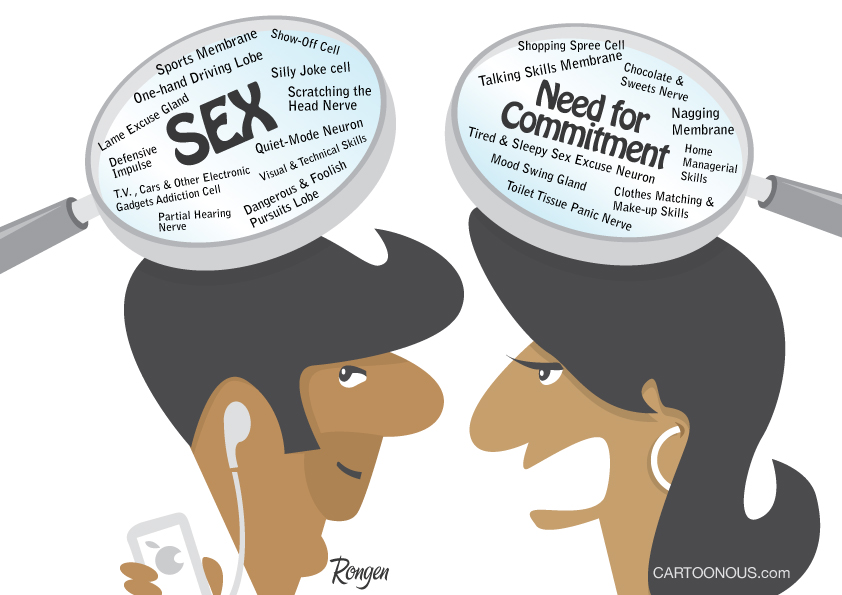
In the reading last night Butler displayed an ideology on the male figure as well as gender roles in general for that matter. Cixiou's comes from a more feminist perspective on the debate between which gender is superior, ultimately siding with the female side. Believing that men tend to lose momentum and begin to go backwards in some areas while woman seem to stay at a constant pace of moving forward throughout their lives. First of all I do not believe that and feel that this is stated in her piece last night as more of a fact when there is no concrete evidence that it's true, meaning it should be labeled to be more of her opinion than anything.
Also being said frequently throughout the readings, which includes all theorists beliefs is how woman are just overall more complex than men. The actions of the female gender seem to more difficult pin-pointing the origin of why than the men who act more sporadically in their daily lives. Once again, I understand the theorists logic, majority of men probably do act more on impulse than woman but once again I feel like a complete labeling is going on here. Not all men do this, I certainly do not. I try and think of consequences before I make a move on anything, which goes to show that these theorists are providing us with what I feel is a biased opinion.
However, these gender readings showed more biased than I believe neutral theorists should give, they nonetheless were easier to read in general. Which I feel can help generate a more solid debate than the other articles like the social class or race one's. All in all, I still believe the superior gender is still unknown and it should remain that way due to argument sake.
Monday, December 2, 2013
Sunday, December 1, 2013
Pre Class
In this reading Helene focused on the ideas behind the ideas of opposites the ways of "activity and passivity, sun moon, culture nature, and day night. She believes that everywhere "where a law organizes what is thinkable by oppositions all these pairs of oppositions are couples? She talked about the idea behind a father and a son. They both need eachother to describe themselves. A father is a figure to provide love and support to a son, and a son receives this, and without the son, a father is a man. She focuses on the ideas that words like sun and moon, and day and night are balanced on each other.
She then goes into talking about the masculine figure. She talks about the ideas of the bisexual figure. That is a hard topic to talk about in todays society. Back in the 1970's and previously, it was something that was almost non-existanst, and people looked at them strangely. Today in our society we can gain a understanding that bisexuality and the modified human figure are that of somebodies choice. There is a hard representation issue of what that figure should represent. Should they become the stereotypical mom if it was a bisexual man to woman. She would always have the ways of a man, and would her feelings be real and true to that of a real mother.
Men today "fear being a woman" This is a understandable trait as women are looked as the week in society, and are dependent on society. Women today are becoming more femist and independent, and i personally like the ways of the 1950's, where women were stay at home, and men made the money. Growing up with just my father working, when my mom said how she used to work, my whole family laughs and says good one, when in reality she had a great finance job. It is the idea that the woman should not be working, they are to stay home and work on the house, and maintaing it.
AsToldByGinger, Cixous and Butler
In these feminist readings Cixous and Butler take different approaches in attempts to explain the roots of societal views on women and feminism.
Cixous discusses the inherent "dual, hierarchal oppositions" that we as a society and human race have used since the beginning of time. - "Activity/Passivity, Sun/Moon, Culture/Nature, Day/Night" (C 157). She says that through these comparisons breeds one victor, which always is subject to man. Although I'm not exactly sure what she means by this, I know what she means by saying that hierarchies usually lead to men.
Cixous then goes on to explain bisexuality which she believes to be something that empowers woman, because it disrupts man. "A man is always proving something; he has to 'show off,' show up the others. masculine profit is almost always mixed up with a success that is socially defined" (C 161).
Butler then goes over how woman has become oppressed culturally and states, "The political assumption that there must be a universal basis for feminism, one which must be found in an identity assumed to exist cross-culturally, often accompanies the notion that the possession of women has some singular form discernible in the universal or hegemonic structure of patriarchy or masculine domination"(C 193). This statement reminded me of the different extremes of how women are treated in different societies, from terrible in the Middle East, to very well in matriarchal societies in Latin America. I think this quote highlights the importance of recognizing these differences, in order to correctly address them - it cannot be assumed that all societies are the same, or that we treat women the same either.
Cixous then goes on to explain bisexuality which she believes to be something that empowers woman, because it disrupts man. "A man is always proving something; he has to 'show off,' show up the others. masculine profit is almost always mixed up with a success that is socially defined" (C 161).
fang- cixious and butler and irragay
The readings on feminist theory were much different than
that of race theory as race theory strongly urged people to avoid othering and
not see racial problems as white v. black problems but people problems. The feminist theorists see distinct
differences (or for Cixious differances) between men and women and a binary
opposition in the two genders.
Irigaray’s piece notes the misconceptions between men and
female sexual organs and the skewed view of sexuality but does not explain the
similarities in the two, but the differences and how those differences cause
many to view sex as a dominating act. She others women saying “woman finds
pleasure more in touch than in sight and her entrance into a dominant scopic
economy signifies once again, her relegation to passivity: she will be the
beautiful object...” (handout 255) fleshing out the misconceptions about female
sexuality. While on some level, there is
certainly a lack of understanding in the inner workings of women, Irigaray
focuses more on female superiority than the overall goal of fostering
understanding and complete equality and empathy across genders.
Cixious’s piece further develops Derrida and Irigaray’s
ideas about different thoughts of sexuality. She focuses on how the writing of
women features more passion and a “privilege of voice” (C 162) and that women
move forward compared to men who revert back to a previous state prescribed by
society. Women, however, “steal language to make it fly” (166) demonstrating a
superiority of women over men.
Lastly, Butler, the most logical of the theorists, takes
feminism from a political standpoint hoping for a “universal basis for
feminism, one which must be found in an identity assumed to exist
cross-culturally, often accompanies the notion that the oppression of women has
some singular form discernible in the universal or hegemonic structure of
patriarchy or masculine domination” (C 193). Butler desires female
representation in the political world and that when that is achieved, it is
more likely people understand the differences between men and women.
It is quite possible I didn’t dig as deep into the readings
as they merit but it just seemed like the readings did not get at the same
solutions and rational thought as the other theorists this semester.
Wednesday, November 27, 2013
ruqayyahali, Cixous & Butler
Helene Cixous speaks about the body and the way that women are supposed to succumb to passivity due to cultural ideology of the world we live in. Women have always been seen as the weaker sex, the ones to be passive while the men are active. We exist in these binaries of hierarchy: there are always two oppositions and one is better than the other.
She says: "We see that 'victory' always comes down to the same thing: things get hierarchal. Organization by hierarchy makes all conceptual organization subject to man. Male privilege, shown in the opposition between activity and passivity, which he uses to sustain himself. Traditionally, the question of sexual difference is treated by coupling it with the opposition: activity/passivity" (C 158).
One way Cixous says that women have 'messed up' this hierarchy, however, is through bisexuality. Being bisexual blurs the lines of binary and hierarchy because one is not required to like the other sex (in this case, a woman is not required to like a man). Bisexuality replaces sexual differences between the two sexes and creates a "a fantasy of unity" (C 159).
She goes further to say that women benefit from this bisexuality because if they embrace their bodies and their sexuality, it is not necessarily for the pleasure or appeal of men. It is for themselves.
Judith Butler, another feminist theorist, goes back a couple steps to say that gender is a social construct. This active/passive binary ideology that Cixous is talking about exists because society fails to recognize that 'woman' is not an overarching term for all females.
Butler says: "Apart from the foundationalist fictions that support the notion of the subject, however, there is the political problem that feminism encounters in the assumption that the term women denotes a common identity. Rather than a stable signifier that commands the assent of those whim it purports to describe and represent, women, even in the plural, has become a troublesome term, a site of contest a cause for anxiety" (C 193).
Both of these authors delve into what has caused women to be the inferior gender. They discuss binaries, ideology, and terms as a way to see how women became the oppressed of the sexes and why all females are even classified as 'women'. Is it simply because they are alike? Or has their oppression bonded them into being alike and thus being constructed as their own gender?
These readings are a breakdown of feminism and what has led to it. Through Cixous and Butler we can explore the ideology behind gender specification that has cause the issue of man vs. woman, masculinity vs. femininity to this day. I look forward to discussing this more in class next week!
Sunday, November 24, 2013
AsToldByGinger, Post Class 11/20
![]() |
| Apparently this is what I've searched this week |
Friday, November 22, 2013
lacansmirror, a retrospective
A retrospective of Macherey from 9/15/13
After looking back at some past blogs, I realized that the ideas in my post about the significance of the unspoken have been seen in other theorists works as well. The importance of Macherey's theory gives enhanced meaning for concepts like the panopticon, Zizek's views on terrorism in America, or Eco's perception of the passivity of guests at Disney. For the panopticon, the unknown presence of someone in the tower of a prison restrains inmates even if it is empty. This emptiness is a physical reference to the importance of "what is not said".
Zizek believes that we produce and glorify in media what we received on 9/11. The notion that we simply accept and encourage violence in movies, and then are shocked when that violence becomes reality, is the unspoken quality that Macherey defines. Our culture does not speak about the effects of our media, but then we are surprised when these events occur.

Finally, at Disney World, guests must comply with the Disney rules while experiencing a prefabricated fantasy, those who actively rebel against those rules are asked to leave. The only way to experience Disney is to remain passive or else they will force silence. Whether it is forced silence or voluntary passivity and acceptance, the notion of remaining voiceless contains the power.
After looking back at some past blogs, I realized that the ideas in my post about the significance of the unspoken have been seen in other theorists works as well. The importance of Macherey's theory gives enhanced meaning for concepts like the panopticon, Zizek's views on terrorism in America, or Eco's perception of the passivity of guests at Disney. For the panopticon, the unknown presence of someone in the tower of a prison restrains inmates even if it is empty. This emptiness is a physical reference to the importance of "what is not said".
Zizek believes that we produce and glorify in media what we received on 9/11. The notion that we simply accept and encourage violence in movies, and then are shocked when that violence becomes reality, is the unspoken quality that Macherey defines. Our culture does not speak about the effects of our media, but then we are surprised when these events occur. 
Finally, at Disney World, guests must comply with the Disney rules while experiencing a prefabricated fantasy, those who actively rebel against those rules are asked to leave. The only way to experience Disney is to remain passive or else they will force silence. Whether it is forced silence or voluntary passivity and acceptance, the notion of remaining voiceless contains the power.
Subscribe to:
Posts (Atom)